CARDBOARD PROTOCOL / PROJECT DOSSIER
KAYA CLI
Physical proximity as temporary digital infrastructure.
CARDBOARD PROTOCOL / PROJECT DOSSIER
Physical proximity as temporary digital infrastructure.
Chapter 01
The cloud was treated as mandatory, even when everyone was already in the same room.
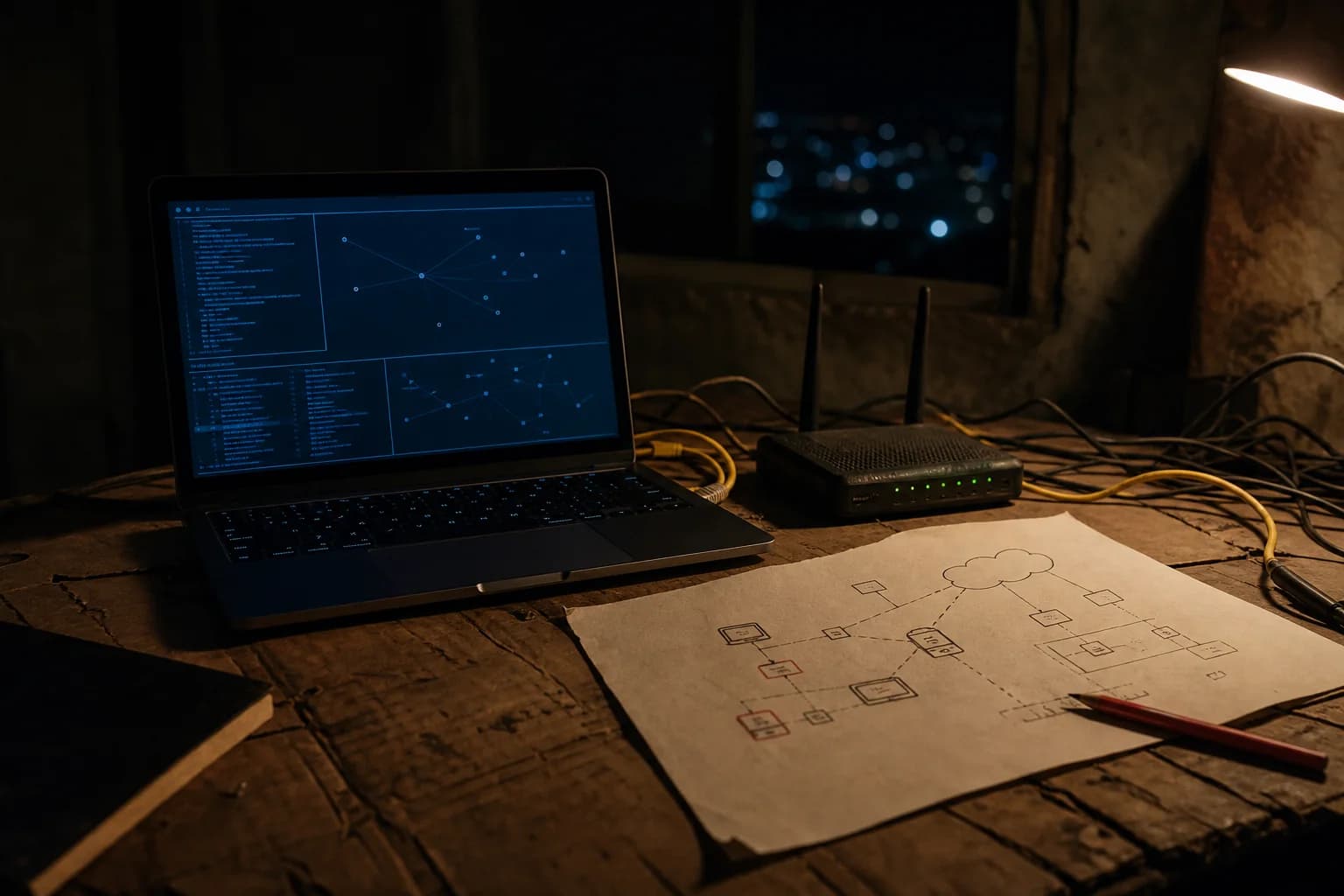
Before the interface, there was a simpler question: why should two nearby devices need a distant server?
FIELD OBSERVATION
People can be in the same room, connected to the same network, and still depend on a server thousands of kilometres away to speak to each other.
The first question was not how to build another messaging interface. It was whether the cloud needed to exist in the loop at all.
Chapter 02
Communication systems assume permanent infrastructure for groups that may only be temporary.
ASSUMPTION
Accounts are permanent. Servers are permanent. Identity is centralized. But many human groups are temporary.
KAYA starts from the opposite model: the digital space appears when the group appears and fades when the group leaves.
Chapter 03
Prove local presence, rooms and messaging before investing in a broader interface.
PROTOCOL
The terminal kept the binary light, the state inspectable and the interaction model visible on modest hardware.
It was a product decision: prove the network and command model before paying for GUI complexity.
Chapter 04
The first model worked only while the network behaved like the diagram.
REWORKED
The first model worked only under an ideal network.
The real problem began when the network stopped behaving like the diagram.
Chapter 05
Preserve local-first as the primary path while adding controlled alternatives.
SYSTEM BOUNDARY
Direct TCP, VPN addressing and an optional WAN relay extend reach without redefining the product as cloud-first.
Encrypted payloads may cross intermediate nodes without exposing plaintext. Mesh remains explicitly experimental.
Chapter 06
Networking, identity, commands, persistence and UI remain separate concerns.
app      commands   direct    events
files    mesh       peer      persistence
protocol relay      rooms     security
shared transport ui sdkChapter 07
Every dependency extends one capability and introduces a visible cost.
Safety, concurrency, networking control and native distribution.
Trade-off: a terminal interface is not suitable for every end user.
Multicast minimizes local setup; relay extends reach.
Trade-off: multicast is not universal and relay must not become an invisible central dependency.
Mesh explores resilience across local routes.
Trade-off: topology, routing and security become substantially more complex.
Chapter 08
The limitations remain explicit because the system is exploratory infrastructure.
CURRENT LIMIT
Chapter 09
Future work is framed as disciplined extraction, not as completed functionality.
NEXT EXTRACTION
Chapter 10
The implementation evidence behind the product thesis.
VERIFIED
language: Rust
runtime: Tokio
ui: Ratatui
identity: Ed25519 + X25519
encryption: ChaCha20-Poly1305
discovery: UDP multicast
reach: direct / optional relay / experimental meshKAYA began as a communication tool. It became an argument: a local network can be social infrastructure, not merely plumbing.
Back cover
A local network can be social infrastructure, not merely plumbing.